Wednesday, September 20, 2017

Three Haikus


Rain hits skylight
Refrigerator Hums
Furnace switches on


Like toddlers from cribs 
Evergreen fingers reach
Into clouds


With jumbo bam bam
Unhinged vagabonds 
Sling the warhead 


Feast

Tuna Fishermen after Dali by GJ Gillespie
by GJ Gillespie

Drifting into nothing
Delightful wishes vanquished
The steady beat of vain hopes
Continue unabated 
While twilight dissolves above
And hearty insects recite  
Anthems of bitter longing
Calculating final degradation 
When best intentions and
Imaginations run amiss
 
Then dare we taste and sip 
Flesh and blood replenished


Last Supper after Dali by GJ Gillespie


Divinity of Christ 1. Jesus Christ is the eternal Son of God: Communication is at the Heart of Reality


"Fifty years ago, the universe was generally looked on as a machine … When we pass to extremes of size in either direction --whether to the cosmos as a whole, or to the inner recesses of the atom--the mechanical interpretation of nature fails. We come to entities and phenomena which are in no sense mechanical. To me they seem less suggestive of mechanical than of mental processes; the universe seems to be nearer to a great thought than to a great machine." 

Astronomer James Jeans --
cited in Kowalski, Gary, Science and the Search for God. New York: Lantern Books, 2003. p 19.


Comments on the Divinity of Christ Creed

We believe that Jesus Christ is the eternal Son of God.

The Scriptures declare:
His virgin birth
His sinless life
his miracles
His substitutionary work on the cross
His bodily resurrection from the dead
and
His exhalation at the right hand of God.

For centuries believers have affirmed these propositions concerning the divinity of Christ. We recite this creed at my church.

Why are these ideas profound? Let's look at each proposition in more detail.

1. Jesus Christ is the eternal Son of God:
Communication is at the Heart of Reality

We believe that God must have the powers of a person since only a person loves. Human love is something extraordinary in the universe. It is a clue that ultimate reality must be something like it. 

If God were a force or principle that would make him less than a human person -- less than yourself -- and thus unworthy of your attention. For example, wouldn't it be strange for someone to worship the force of gravity? Or to make an electrical field into a god. That would be like the ancient practice of idol worship when people built gods of material objects. 
God must be at least as special as a human person, aware of what is happening and able to experience relationships. Only a person can love. Whatever created us must be at least as good as a person.

It is much more likely to say that God is not only personal but more personal that we can understand. Divine personhood is of a different category than we observe in daily life because God is more personal than is imaginable. We could say that God is supra-personal. 

Christian teachers tell us that God is three persons in one being -- Father, Son and Holy Spirit. Three co-equal persons in one nature. When first encountered, the trinity seems strange, but turns out to be essential for consciousnesses to exist. 

http://thethirdcup.com/wp-content/uploads/2012/04/god-is-love-ipad-wallpaper-300x300.jpgThis creed statement that Jesus Christ is the Eternal Son of God affirms that communication and community is at the heart of reality -- or is the source of reality as the Ground of Being. There is communication within the nature of God. The Father loves the Son and the Son loves the Father and the Holy Spirit loves the Father and loves the Son and so on forever.

Or as scripture says, "God is love."  The communication going on within the nature of God is self sufficient. His love is with out reference to any created person. Even if God never chose to create a universe, he would still be love.

Everyone knows that love must be the meaning of human existence. In a letter to a woman who wrote asking for a word of inspiration for her son, physicists Richard Feynman near the end of his life replied: Tell your son to stop trying to fill your head with science — for to fill your heart with love is enough.

(Sykes, Christopher Simon, No Ordinary Genius: The Illustrated Richard Feynman, 1996, by, p 161.)

Christianity gives a rational source for this love in the ultimate love that goes on in the nature of God. The book of James states in 1: 17 that: "Every good and perfect gift is from above, coming down from the Father of the heavenly lights, who does not change like shifting shadows."

Humans benefit from the outplaying of divine love when we share the gift of conscious awareness, enjoyment of relationships and contemplation of beauty and the experience of joy. 

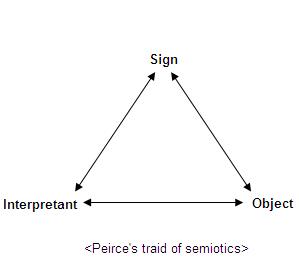
http://csmt.uchicago.edu/glossary2004/semiotics/semiotic_triad.jpgThe doctrine of the trinity diverges from polytheism -- or belief in three gods -- since the three persons are of one substance. Rather the triune nature of God reflects the same semiotic processes that make any meaning possible in each mind. Semiotics is the study of how symbols produce meaning. All linguistic processes require a sort of trinity of the mind -- a connection between a person's thought, the objects observed and the symbols or words used to communicate.

Communication scholars Osgood and Richard's Triangle of Meaning uses the terms Reference, Referent and Symbol. Another theorist, Charles Sanders Peirce uses the terms Sign (words or symbols), Object (thing experienced) and Interpretant (person making observations).

A conscious person contemplates a referential object or idea and the meaning that is achieved in this process gives coherence to the subject and object as a unified whole. A person becomes aware of meaning when the referent that is sensed is understood by language. So, we have a person, a referent (idea, object, experience) and the language or imagery that connects them.

These semiotic models resemble the Christian doctrine of trinity explaining the communicative nature of God. Here there are three persons each playing a role in the Being of God. God the Father is like the Object or Referent. The Son of God is like the Sign and the Holy Spirit is the Interpretant. The parallels fit neatly since any kind of consciousness demands a triad of three in oneness.

It turns out that the connection mesh well because, as philosophers of religion have pointed out, these and other triads of the mind were inspired by the trinity as conceptualized by Augustine and then Hegel. Peirce is said to have been greatly influenced by Hegel. 


Moreover, the concept of three in one equal but distinct seems to provide a workable method for understanding how the mind works in creating meaning. There are crucial features which make the trinity the only candidate to explain how the conscious mind produces and shares meaning.

We do not think of the trinity as belief in three gods any more than we think of the triangle of meaning as three separate properties. All three are equal and necessary for meaning to be realized. Yet, each is unique and separate at the same time. There is a "three in oneness" in both the divine trinity and semiotic triangle. Perhaps we could say that God is a cosmic Triangle of Meaning, a fountain head of all meaning and real communication.

Notice also that meaning requires community -- or the coming together of persons in a common bond of shared language and culture. The individual person only gains the resources of language from the community. An isolated individual without a community would never acquire language or the power of semiotic thought. Child abuse cases demonstrate why community -- or at least three persons -- is required for language, love and meaning to exist. As a normal child grows up he or she acquires the third leg in the triangle by "borrowing the minds" of adults, taking on the perspective of parents or role models, mimicking their identities to achieve their own. In this way a child grows up as both an individual and a member of the collective community. This is called inter-subjectivity -- taking on the perspective of others to gain ones own. 

Without community -- or the three-in-oneness principle -- there can be no shared meaning, communication or love. Therefore viewing God as a single mind -- what is called monism --denies the possibility that God would have a consciousness required to love and be loved.

When we consider that the trinity is incomprehensible we are reminded of the mysteries of recent discoveries in quantum mechanics.  Paradoxical features of quantum reality have been proven by scientific investigation. Light for example is both a wave and a particle at the same time. This counter-intuitive property is known as the wave--particle duality. Just as strange, subatomic particles are able to exist in two (or more) places at the same time. These are not illusions or metaphors but physical realities on the microscopic scale.

The physicist Niels Bohr once said: "Anyone who is not shocked by quantum theory has not understood it."  (Gribbin, John, Mary Gribbin, In Search of Schrodinger's Cat: Quantum Physics and Reality, University Press, 1984.)

Richard Feynman, who understood the physics of quantum mechanics better than anyone, concluded that actually: "Nobody understands quantum mechanics." (Rosenblum, Bruce and Kuttner, Fred, Quantum Enigma, Oxford Press, 2006, p 80)

When Feynman made his famous diagram he said that there are some properties of quantum reality that are so strange that we don't even have a metaphor to contain them. We know by objective experiment that these paradoxes are real (not theory) but we are unable to intuitively conceive of them without great mental effort.

"Our imagination is stretched to the utmost," he said, "not, as in fiction, to imagine things which are not really there, but just to comprehend those things which are there. (Richard Feynman, The Character of Physical Law, 1965. )

Here is the Feynman diagram which attempts to graphically illustrate quantum mysteries that take place on an unimaginably small microscopic scale.  The stuff that forms our world is made of positive and negative electrons interacting with packets of energy called quanta that travel forward and backward in time (could be what this means).
http://upload.wikimedia.org/wikipedia/commons/thumb/1/1f/Feynmann_Diagram_Gluon_Radiation.svg/287px-Feynmann_Diagram_Gluon_Radiation.svg.png
In the same way that certain realities about the physical universe are nearly impossible to conceptualize, the closest metaphor that a human mind might grasp about the divine nature is to say that God's consciousness is like the love between a father and a son in a family. Christ as the "Son of God" alludes to the inheritance rights of a first born son of ancient Hebrew culture, the one who has equal legal standing with the father and acts in his stead. Two persons with one substance.

In this sense, Christ the Son of God becomes the necessary intermediary between the wholly other God the Father and human beings in the material universe. Like the yellow light between a red and green light of a traffic signal, we now have the possibility to mediate our limited consciousness with divine meaning and know something about God through the person of Jesus Christ. 

World without End by GJ Gillespie
In fact, traditional Christian belief attributes the creation of the universe to Jesus Christ -- the one who is wholly God and wholly human at the same time. While this doctrine of the dual nature of Christ  -- who is the simultaneously divine and human Creator --  like the trinity seems strange at first, the divine-human dual natural may provide an explanation for how the information of the universe came into being. 
With the advent of Quantum Mechanics, especially the Copenhagen School which argues that reality requires conscious observation, physicists have introduced us to a strange world that at its core is, in the words of Shakespeare, made of the airy stuff of dreams. Rather than the hard stuff of everyday experience, reality most basically exists because information is being perceived by some kind of Interpretant.
 
So we might ask who dreamed up the universe? Who provided the informational scaffolding that holds up time, space, matter and fundamental forces?

Quantum theory argues that there must be a conscious observation of particles before those particles become reality. It takes conscious activity to "collapse the superpositions" of the virtual particles to physically make the universe real.  This observer can't be the all knowing God the Father exactly since he would presumably already be aware of all positions. It would take a mind that is limited, like a human-like mind to make these observations within the physical universe.

Theologians grappling with how an infinite personal Being might interact with the world say that when Christ became incarnate he did not lose any of his all knowing attributes since God is immutable or is incapable of changing. Instead the incarnate Christ took on human nature in addition to his divine nature. Theologians maintain that in order to act in the physical universe -- and interact with humans -- God "condescended' from the first moment of creation taking a "covenantal" or human like perspective in addition to his all-encompassing divine perspective.

Pehraps we can think of God in Christ "condesending" in the way that the author of a story "enters into the story" by imagining the perspective of his or her characters. The author is aware of his or her own world, but for the purposes of creative writing imagines that he or she is a body acting in the story. The author may even communicate with characters, telling them what to do in his mind. Similarity, characters sometimes "take over" a story and choose to act in ways independent of the author's initial will. 

Divine condescension -- God getting into the story -- explains how an omniscient mind would not collapse all positions in the universe at once.

Once a particle is observed its "wave function" become set for ever. For example if a photon is consciously viewed as a particle is becomes a particle forever. And, counter intuitively, the observation effect works backward in time. Once it is observed as a particle, it has always been a particle or always been a wave caused by the observation in our time.


All Fall Down by GJ Gillespie

The fact the consciousness forms reality is called the "quantum enigma" and suggests that the acts of a mind is necessary for physical reality to exist. Some physicists discount the enigma by assuring us that the effects only occur on a very small scale that is invisible to the macro world we live in. But, Rosenblum and Kuttner point out ignoring this proven feature of physics isn't enough since the macro world is made up of the microscopic world. "Quantum mechanics applies to everything", they argue. (Rosenblum and Kuttner, p 15)

If God is all knowing, then all of the positions would already be observed. But, if God limits his knowing, in the same way that my wife working on a painting for two hours limits her knowing what is going on with current events on the internet. An artist condescends by focusing attention on the artifact being created. It is a limiting of the mind that permits novel information or patterns to pop up. The nature of the final artifact, such as a story, poem or painting, is never quite what the creator imagined at the start. This is the mystery of creativity. The exciting effects of limiting a mind and letting the artifact take over.  The creative act requires discipline of a focused mind, wholly committed to seeing the vision for the art fulfilled.


Perhaps God is acting in the same way that the human artist, 
sculptor, poet, composer or painter "gets into" the created work, focuses on it intensely, sometimes so intensely that everything else in the world fades away. The artifact becomes the center of attention above all else, even sleep or eating. 

It could be that God chooses not to collapse all superpositions because he is playing along -- as if he were a human-like actor in the universe, limiting his all-knowing mind for a time to see what emerges.

While some have argued that the universe evolved to the stage of the first human who looked back on it to create it retroactively or that this first observer was Adam of biblical narrative, it seems more plausible to accept that the conscious observer is God the Son exactly as set forth by scripture such as the book of Colossians 1:15 -- 17. 

"The Son is the image of the invisible God, the firstborn over all creation. For in him all things were created: things in heaven and on earth, visible and invisible, whether thrones or powers or rulers or authorities; all things have been created through him and for him. He is before all things, and in him all things hold together." 

Christ as the Word of God spoke the universe into being, providing the information that makes up the structure of reality. In addition, the semiotic-like mind of Christ holds all things together like grammar holds the meaning of a sentence together.  Christ is the universal "Logos" or underlining meaning behind all that we experience.

Or, put negatively, with out God we lack the grammar to understand meaningful patterns in the data of experience. Some non-Christians believe that the realization that there is no linguistic-like binding force behind phenomena is key to enlightenment. They will say that we need to extinguish this desire to see an encompassing oneness or nothingness. 

The Christian creeds offer a life affirming perspective. Ultimate reality isn't nothingness. But, is a Person. And all that we experience is a divine artifact. The creeds permit us to hear the rhythms of a celestial music. Behind reality rings the Music of the Spheres. The composer is an awesome, creative God. 

Unsurprisingly, string theory -- one of the newest candidates to explain cosmic origins -- also refers to  a musical metaphor. This proposal of theoretical physicists suggests that at the smallest scale -- 10 meters to the negative 33 (ten with 33 zeros after it) -- there are tiny "strings" that exist at the border of time of space. The vibration of the strings forms larger scale objects. When the string vibrate at one frequency, a carbon atom emerges. At another frequency, helium atoms or other material properties pop into existence. In this view, the "music of the spheres" literally forms reality.

The string is not really a physical object since it is so small even time and space break down. It appears more like an idea or a mathematical algorithm. Could these strings be the expression of thoughts of the communicative, triune God as laid out in the creed? Such a perspective would be an eloquent explanation. The mystery and beauty of universe is the outplaying of a musical score,

Physicist John Archibald Wheeler argued that the universe can be rendered down most basically to information. That everything -- it -- comes down to bits. This is the It from Bits theory.


"[I]t is not unreasonable to imagine that information sits at the core of physics, just as it sits at the core of a computer. It from bit. Otherwise put, every 'it'—every particle, every field of force, even the space-time continuum itself—derives its function, its meaning, its very existence entirely—even if in some contexts indirectly—from the apparatus-elicited answers to yes-or-no questions, binary choices, bits.

'It from bit' symbolizes the idea that every item of the physical world has at bottom—a very deep bottom, in most instances—an immaterial source and explanation; that which we call reality arises in the last analysis from the posing of yes–no questions and the registering of equipment-evoked responses; in short, that all things physical are information-theoretic in origin and that this is a participatory universe.
 (John Archibald Wheeler 1990: 5)

http://upload.wikimedia.org/wikipedia/commons/f/f3/Magnetosphere_rendition.jpg
What good is it to say that information exists without a mind to process and contemplate it? While Wheeler took a monist perspective of eastern religion that each person is really part of a divine consciousness without realizing it, the Christian will say that the observation of information that forms the bits that make up reality come from the mind of the Triune God. This mind is surpra-personal and capable of great love.

Could this mind that produced the cosmic information be a "Universal Consciousness"? Could the universe have a mind and we are simply part of that mind? That is unlikely. 

Think back to the triangle of meaning. For the perception of information to make sense, to produce meaning, there must be three in one. Three aspects are required for information to exist: We need information, perception of the information and an object that the information is about.

But, if "all is one" -- the expression of a single mind only -- then there would be no place for information and no need to communicate about it to anyone.

Usually artists and writers are interested in how their art form will be appreciated by others. Great artists or writers have large audiences of admirers. That is what makes them great.

Love requires communication -- first in the community that makes language possible, then between at least two persons. There must be interaction between persons. 

While the monist universe could not be the source of its own information since information requires the semiotic triad, the Christian perspective is that God is One, but God is also Three at the same time. Three in Oneness. It is from the communication within this Being that the information we see in the universe comes to exist. In fact, we are made up of this information.

All we know, including ourselves, are artifacts of a divine mind that stands far outside of the universe. We are made in God's image, able to participate in the appreciation of the beauty of universe and -- most important -- form loving relationships. To love and be loved. 

Traditional theology posits that humans also take part in the development of the universe since God chooses to use us in his restorative work. God loves each human being and has a plan for each person. We are God's handiwork created to enter into relationship with him and can know his plan for our lives.

When we accept that Jesus Christ is the Eternal Son of God we are saying that our lives and the universe have meaning that is back-lit by an after glow of a love that is so great it forged the explosion of the Big Bang.  As astronomer James Jeans once suggested, the advent of quantum mechanics makes the universe appear more like a thought than a mechanical object.  Its the thought that counts.

http://trumanfalkner.files.wordpress.com/2009/03/creation.jpg
There are beneficial philosophical implications to viewing the universe as a grand thought of a loving Being instead of a blind mechanistic object.

Our reality becomes an artifact of beauty and mystery that can be experienced meaningfully. Our world can be enjoyed like a work of art.

"And God said, 'Let there be light,” and there was light. God saw that the light was good...'" Genesis 1: 3, 4a.

This passage supports the information theory basis for reality. God chooses to permit information to enter his consciousness. He then speaks this information meaningfully which results in the appearance of a world. Finally, he evaluates or experiences it.  Could this progression mean precisely that God's conscious conception of primordial-information is what led to the collapse the wave function and the birth of reality? 

At its core, matter, space, time and fundamental forces rest on divine algorithms that make up universal complexity. But, since the Creator is more like an artist than an engineer he observes that it is good. This is the inner information states of aesthetic experience. The universe as an artifact of the communicative Triune God is embedded with experiential meaning that can be enjoyed by persons. 

The mind of God is then able to contemplate the information as an artist might appreciate his or her handiwork, producing the phenomenological response of subjective knowledge that forms the basis for values and aesthetic appreciation.

Instead of mechanistic, digital processes we might expect in a dead, static cosmos, we find that the universe is a grand thought that rings with analogical information more like cosmic poetry or music than mathematical equations.  God's existential observation become a fountain for all beauty.  And we can drink from this fountain.

We do not confuse the universe for God. Nor do we think of ourselves are part of the divine mind unaware. Rather, the universe is like a house that is inhabited by a charismatic owner. The personality of this owner fills the physical house with immaterial joy. Our mind is like his, just as a child's mind is like a parents -- similar but not identical.

So on one hand there is the measurable information of objective science, physics and psychology, while on the other the subjective appreciation (phenomenology) of beauty, love, truth and religious meaning.  By knowing the mind of Christ, human beings now have a trustworthy path to enter into a knowledge of true values and beauty. This experiential appreciation of the cosmic information then forms the basis for arts and ethics and authentic religious experience. Reality exists because the Triune God speaks it into being in accord with information theory. Since it is highly valued by his omnipresent observation we know that it is a thing of beauty and love.

http://www.andybarlowblog.com/wp-content/uploads/2010/04/Jesus-Christ-art1.jpgAccepting Christ as the eternal Son of God and Creator of the Universe provides an infinite reference point upon which meaning can be realized. Instead of a "castle in the sky" without any firm foundation, language has a solid ground in the consciousness of the Creator. The Mind of Christ which exists at every point in space and time then experiences his creation, from the most minute micro level to the cosmic macro level, imbuing it with value. Likewise, God as our Creator knows each person fully, providing the possibility of knowing our true selves as well. We can join in the observations of this divine mind, thus experiencing eternal joy, love, acceptance and purpose.
                                                                                                         
Faith is turning toward God. Away from the absolute cold in the abyss of nothingness, and toward the warmth of God's love. We might turn just a little bit toward God. That may be enough. We can learn to hear the music of the spheres.

Why settle for knowing about God when knowing God is possible? 

An alternative universe is open to us when we say yes to Christ. Everything changes. We find peace, meaning, purpose, freedom from guilt and drink from the headwaters of all beauty. 

Exploring an Alternative Universe


One technique for developing faith is the experiment of "suspension of disbelief". This is a first step toward experiencing reality as a follower of Christ. 

For a set time you may choose to accept the perspective that you are an artifact of a loving, all knowing Being who wants to know and communicate with you. 

Try it out for a while and see if it makes sense. If a communicative God exists behind reality and at every point in time and space, it should be possible to tap into the lines of communication that is flowing in that Being.

Prayer is simply talking to God. Request that he help you believe and reveal himself to you. Then wait for the feedback in some event or inner knowledge to confirm your faith. 

Interaction with Christian friends during this experiment also helps if you know some believers.

An essential part of this experiment in faith is to read up on the Word of God in the bible to get acquainted with the mind of Christ as he interacted with people. Find a bible and read the Book of John and be open to hear the voice of God speak to your inner life.

NOTE: post a comment below and I will pray for you about your new faith journey. 


Thursday, March 3, 2016

Lenten Sonnet


by GJ Gillespie  
Life Cycle by GJ Gillespie

                    
The vanity of recompense 
Shows through its artful eye    
Unsung lusts for love long lost
A twist too tight, a smile too broad
A yearning for composure
Fleeting dreams and sentiments 
Of sweepers stirring sand 
Or sparrows falling silent
Like celebrants remember
Desperate incantations of ice and earth
And nod in reverent prayer
While somber silhouettes spill into darkness 
and all is quiet as the air 
in fields of rotten crops


SaveSave

Sunday, April 27, 2014

A Debate Coach's Farewell Address

by Gary Gillespie

Kirkland, WA. April 25, 2014

I want to thank Jacob and Autumn Witt for inviting us into their home for this year-end celebration. Thank you for the wonderful barbecue dinner. Autumn and Jacob met as debaters on our team years ago and returned to teach here at Northwest University. I’ve said before that if I could choose anyone to take over my role as Eagle Debate Coach it would be Jacob.

Megan and Autumn
First place at Portland CC

Proverbs 16: 24 says “Gracious words are a honeycomb, sweet to the soul and healing to the bones.” 
Tonight I want to share three words of encouragement for Jacob and our graduating seniors. During my sabbatical I’ve been working on some art and I brought a miniature painting I’ve made as a gift to Jacob to sort of pass the torch. This 4 by 6 inch watercolor of a bee is encased in bee's wax.

I give this artwork to you Jacob -- asking that you might “bee” a better coach than I was.

Organizational communication experts say that there is a test to judge whether or not you are a success as a leader. What do you think it is? Increased productivity could be a test, but the one that I am thinking of is the test of reproduction. If you can reproduce yourself as a leader, if you can train and mentor someone else so that when you leave they can take over -- and not only take over but do a better job that you did -- then you can say that you have been a success.

The arch of my heroic journey is coming to an end. It isn’t over yet because I will still be around to help behind the scenes with the debate team. But, if you count graduate school, I’ve been coaching debate for 30 years now and I think that 30 years is enough. As I look back I feel a sense of satisfaction and pride. Our team has won a lot of awards over the years. The judges haven’t always gone our way, but we’ve known tremendous victories. Over and over the students from our small school faced the best and brightest debaters from major universities and nationally ranked colleges and still came out on top. 

Jacob Witt and James Stewart in Seattle Times

It all started with Jacob Witt who was elected three years in a row as our team’s first captain. In his senior year he and his partner Josh won first place at the Willamette University Championship then advanced at nationals. Now it ends for me with team captain Calvin, elected three years in a row, who with Abbie also won first place at Willamette and advanced at nationals. And not only did they advance at nationals but came home from Purdue University with a quarter finalist award – the best national record of NU history. It places us as the second top BP debate team on the west coast.  That is the thrill of victory.


Credit goes to the leadership of Calvin whose intelligence and hard work spurred our team on to a higher level of performance that paid off all this year. He is really one of the best captains we’ve had and made us all proud. We’ve all shared in the glory.
Jacob and Josh Brittingham first place at Willamette U


I’ve had the privilege of standing by and watching students earn recognition at hundred’s of tournaments. I think of one student named Loren who worked really hard on a persuasive speech about indigenous people’s land rights in South America. He won first place at a Western States Communication Association tournament in Coeur d'Alene. And I remember him at the awards ceremony just beaming. He held his trophy and looked up at me and said, “I’ve never won anything before!”

I could tell you so many other stories of students who won awards at a time in their maturation when they need to know that they can take on a challenge and succeed. I’ve shared in those moments of victory. It’s been a joy.

My college pastor Brady Bobbink up at Western Washington University in Bellingham gave us career advice once. He said choose a career in which you can pour your life into the lives of others. Then your reward will be eternal. And that is what I did.

That is the first word of encouragement for you tonight –you need to place high value on relationships. It isn’t winning armful of gold figurines. It isn’t the plaques, medals, cups or wooden gavels we might acquire. You know, afterwards we go home, toss the trophies in the closet and forget. I usually tried to make sure that graduating seniors took home their awards from the trophy case because I forget who won what after a while.
John King and Troy Henley win gold pan at
 Great Alaska Speakout

What really counts are the friendships that we’ve shared. We may forget who won what when, but as
the years pass we realize that all those trophies getting dusty in a cardboard box somewhere only represent the true prize that lasts in our memory. Those feelings of comradely shine brighter than the bronze on any award.

I consider the relationships that I’ve shared as a coach with students these past years as the crown jewels of my career. 
Annalise (left) and Calvin (right) with John and Marlene
winners of Oregon State Prison Debate 2013

So, when you pass through the brick gates of Northwest University as a student for the last time, be sure to nurture friendships in whatever endeavor you pursue.

Years ago I remember a talk at the NU chapel in which a highly successful youth pastor in our region was asked to share how she did it. She said that the reason she is known as a success is that, unlike her classmates in youth ministry with whom she graduated, when it got difficult she didn’t quit. 

Sort of like: “the winner is the last person standing”. She said that that is the test of whether or not you are called to the ministry. When you get discouraged because people are not responding immediately you don’t give up. You keep at it. They say that it takes 10,000 hours to become good at anything. So, put in the hours. Don’t easily give up. Winston Churchill, the British prime minster during World War Two and one of the greatest leaders in history said: “Success is not final, failure is not fatal: it is the courage to continue that counts.” 

That is my second word for you tonight – if you want to be a success at anything you must persevere.  

My final bit of encouragement comes from the Iliad. While working on art at my kitchen table during my sabbatical these last few weeks I’ve been listening to an audiobook of Homer’s stories of the Greek heroes who sought glory during the Trojan wars. It was written in 800 BC. Book 18 tells the story of how Achilles received his magic shield. The blacksmith god Vulcan made invincible weapons of metal for the heroes and other gods. He spent a lot of time making Achilles a special suit
Andee and Abbie win at
Linfield College
of armor. And Vulcan was an artist. On the shield he engraved intricate images and designs. One image on the shield was the bear constellation. We know it as the big dipper or Ursa Major. Homer said that the bear constellation is the noblest group of stars in the heavens because this constellation doesn’t dip into the sea. It is circumpolar, and remains fixed in the night sky. All the other constellations revolve around it. Being able to spot the Bear was important to the seafaring Greeks because they could use the North Star to navigate and find their way home.

For Christians the North Star is Jesus Christ. T. S. Elliot said that Jesus is “the still point of our turning world.” No matter what difficulties, hardship, grief, disappointments, broken relationships or challenges that you face in this turning world of change and transition, you can look to Christ to guide you. He will be your shield and defender. With Christ as your North Star you will discover a life of deep meaning and peace. Pastor Rick Warren wrote a book called “The Purpose Driven Life”, in which he said that “It isn’t about you.” When you are following Christ the purpose of life isn’t about your own happiness, contentment, success or glory. It’s all about him. He is your purpose.

Brandon and Tiffany win at Hawaii Pacific University
So my hope is that in knowing Christ’s purpose you will find your own.

In a sermon to college students Martin Luther King put it this way:

"I would urge you to give priority to the search for God. Allow his Spirit to permeate your being. To meet the difficulties and challenges of life you will need him. Before the ship of your life reaches its last harbor, there will be long, drawn-out storms, howling and jostling winds, and tempestuous seas that make the heart stand still.

"If you do not have a deep and patient faith in God, you will be powerless to face the delays, disappointments, and vicissitudes that inevitably come….

"But with him, we are able to rise from tension-packed valleys to the sublime heights of inner peace, and find radiant stars of hope against the nocturnal bosom of life's most depressing nights. Augustine was right: "Thou hast created us for thyself, and our heart cannot be quieted till it find repose in thee".
( Martin Luther King, Jr. Strength to Love, "Three dimensions of a complete life." 1968. )
Finally as our time together ends, I want to ask you to do something. This summer on a clear night go outside and look up at the Big Dipper, Ursa Major, the Bear. And when you do remember that the nose of that bear is pointing toward the North Star and that you should too. That is what I’ve tried to do in my career.
Abbie and Calvin reach Quarter finals
2014 Nationals out of 180 top teams


Before we end in prayer I’d like to conclude by reading these words from Paul in Second Timothy 4.

“In the presence of God and of Christ Jesus, who will judge the living and the dead, and in view of his appearing and his kingdom, I give you this charge: Preach the word; be prepared in season and out of season; correct, rebuke and encourage—with great patience and careful instruction…. [K]eep your head in all situations, endure hardship, do the work of an evangelist, discharge all the duties of your ministry.

For I am already being poured out like a drink offering, and the time for my departure is near. I have fought the good fight, I have finished the race, I have kept the faith. Now there is in store for me the crown of righteousness, which the Lord, the righteous Judge, will award to me on that day—and not only to me, but also to all who have longed for his appearing.”


Sweeping at Seattle University
__________________________________________________

If you are a former NU debate 
or speech team member I would enjoy seeing a post from you below or at Facebook. 


Friday, February 28, 2014

Binary Opposition in the Comedy of Errors

An Actor's Analysis of Shakespeare's First Play


By GJ Gillespie

As members of the species called the "story telling animal" we long to enhance our sense of self and society through hearing tales that provide templates for thinking about our place in the universe. Shakespeare's ability to tackle profound psychological and existential questions that haunt humanity has long made him a celebrated literary prophet.  Performed for centuries his cannon of tragic and comic plays are as popular as ever.

Over the years I have seen most of Shakespeare's commonly produced plays -- some plays multiple times. So it was a delight when I had a chance to act in a production at our university. The experience of moving from fan to actor provided new insights into the brilliance of the literature. A record of these musings may help others appreciate the power of story to reshape human identity.
Prof. Gillespie as Egeon, father of the twins

Isaac Asimov calls the Comedy of Errors, thought Shakespeare’s first play, a “total farce”.  The play tells the story of one day in the life of a separated family of twins who happen to arrive at the same city unaware.

(Isaac Asimov, Asimov’s Guide to Shakespeare: A Guide to Understanding and Enjoying the Works of Shakespeare, Wings Books, New York, 1970. P. 169.)

Audiences laugh at the characters' implausible mishaps and mistaken identities and are warmed by the happy ending when the family is re-united. Surprisingly we are not only entertained but aesthetically elevated. We leave the play house with a renewed faith in the possibility of reconciliation. We are moved beyond what we would expect from witnessing a series of jokes by laughable characters.

Because the play, perhaps more than others, ideally models the binary structure of drama it is worth a closer look.

By pairing contrasting images in sequences Shakespeare orchestrate a story of salvation, culturally familiar to original audiences but neglected by us today.

Uncovering rhetorical meanings beneath the play's surface is best achieved by focusing on the character of Egeon, father of the twins, who appears in act one to present his apology and explain how the family was separated, then again in act five in a final defense awaiting execution.

The lines for the "hapless Egeon" are tragic and his tone serious. His pleas are juxtaposed with the silly jokes and slapstick banter of the other characters. We could explain his melancholy as foil to amplify the overall hilarity.  Or we could see him as the scapegoat of the story, a Christ figure, who fulfills the mythical aspirations of the viewers that the conflicts and confusions of the human condition might find happy resolution.

In what follows let me call attention to key contrasts that amplify the humor of the plot and set up the pleasing denouement in the final act.

First I will sum up comic devices used in the play, second reveal the structure of binary oppositions that make up the conflict, finally examine the meaning of key metaphors, devices and props that are imbibed with theological meaning.

There are two theories that explain humor, incongruity and superiority.

First, when a person recognizes that two states are out of sync or contradict one another he or she experiences the pleasure or delight of knowing. This "now I get it" or appreciation of the joke, permits the conscious mind to rise above the irony and gain, what Kenneth Burke calls, a perspective by incongruity.

(Kenneth Burke, Attitudes Toward History: Third Edition with an Afterward, University of California Press, Berkley, 1984.)

The enjoyment of the incongruous humor -- signaled by an outward laugh or inner delight -- bridges the kind of mental gaps that the mind faces daily in trying to grasp recognizable patterns in the chaos of the world.  Humor makes the world feel connected. The knack for amusement in all things, not taking the absurdities of life too seriously, to laugh and enjoy even in the face of hardship, is a life skill aided by playwrights like Shakespeare who understood our need to experience the gestalt of psychological wholeness.

Irony is the comic device in which the recipient is meant to believe the opposite of what is said. Throughout the play the audiences see what the character’s miss. The characters say one thing, but we know that the opposite is true. Adrianna calls Antipholus of Syracuse “husband” when we know that Antipholus of Syracuse just arrived in town.

The second way to explain humor is showing superiority over a victim. Much slapstick humor is funny because we tend to laugh at the plight of characters who suffer indignities or unlikely hardships. Usually the victim’s plight is exaggerated to the point of absurdity. The Three Stooges, a popular 1940’s film series about three goofy friends who constantly get into trouble, illustrate this second device. Unlike our normal reaction of seeing a person physically hurt, the context of the farce causes amusement. When Mo pokes Larry in the eyes with his fingers we laugh. We enjoy our position of superiority over the poor sap who is the brunt of the joke. 

The amusement of feeling superior is the basis for jokes that make fun of people in other groups from our own and is the basis for sexist or racist humor. We may make fun of people who live in another city or who have a different occupation, language or social standing. The comic television series Portlandia constantly makes fun of people who live in Portland, showing the viewer’s superiority of living in their home city that isn’t “crazy”.  In the same way, we may make fun of people or classes who have power over us. Our boss, professor or the ruling political party may have power over us, but we compensate by laughing at them. 

Another factor of humor is exaggeration. Jokes may be overstatements, in which something is said that is far more than it actually is and understatement in which something is said to be far less than it actually is. Because we know that in actuality reality differs from what is stated exaggeration feeds our sense of irony.

In The Comedy of Errors Shakespeare utilizes all comic devices, especially exaggeration.  In Act one Egeon is brought before the Duke of Ephesus, charged with the crime of trespassing. We learn Ephesian law forbids any citizen of Syracuse from setting foot in their town. Egeon, a citizen of Syracuse, is on a journey searching for his lost twin sons. The punishment is a large fine or death. Although formally wealthy, Egeon has spent all of his money on his quest, and because he has no friends in town to pay the fine he faces execution at sundown. He seems resigned to die, preferring death to his unresolved hardships.

The Duke is curious what those hardships might be and asks for a defense for why he came to the forbidden town. Egeon then goes into a long monologue providing the audience with the backstory. He explains how he became separated from his wife and one of his twin sons in a shipwreck. It turns out that each twin son was paired with a servant who also had a twin brother.


We could find humor in his unlikely hardships, but the tone of the text doesn’t seem funny. The tone and length of the monolog is problematic for the actor who must win the attention of the audience. An exaggerated delivery with vocal variety and sensory showing is key.

Perhaps the original audience would find humor in an old man telling an absurd story of heroically surviving a shipwreck. Exaggerated travel tales would be common entertainment in pubs in the 16th century. A modern comic parallel could be how we might laugh at an old man saying “young people have it easy today. In my day we had to walk five miles to school barefoot in the snow….” We put ourselves in contrast with the person with whom we laugh at.

Humor is pleasing because discordant neural synapses are connected by a joke. It is mental stimulation. The opposite is boredom. The elevating mental connections that occur in irony are similar to the engagement of dramatic storytelling.

In his study of cultural myths anthropologist Levi Strauss discovered the basic structure of binary opposition between opposing forces and people in any good story. He theorized that in order to make sense of the world human beings notice what is familiar and contrast accepted, comfortable assumptions with what is foreign and abnormal. Binary opposition forms the basis for cultural values. We know what is bad by contrasting it with what is good. Stories follow a structure in which conflict between two forces is resolved, thus providing the needed mental glue to bind together what would otherwise be inscrutable.
(Lévi-Strauss, Claude. Structural Anthropology. Trans. Claire Jacobson. New York: Basic Books, 1963.)

The Comedy of Errors has binary opposition between all levels possible dramatic conflict. There is struggle between social class, social order, societies, nature and supernatural forces, between family members, siblings, between agents of commerce, slave- master, husband-wife, male-female romance, and sacred order versus the profane order. By the end of the play all of these factors of disorder are resolved.

In Acts Two to Four we find other contrasting images that form the basis for dramatic interest as well as humor.

Antipholus of Syracuse vs Antipholus of Ephesus.
Dromio of Syracuse vs Dromio of Ephesus.
Merchant demanding payment vs unwilling customer
Antipholus of Ephesus vs his wife Adrianna (who each suppose the other is unfaithful.)
Adrianna vs both Dromios.
Antipholus of Ephesus vs both Dromios.
Servants inside the locked house vs Dromio of Ephesus outside
Sacrilege of magic vs sacredness of holiness.

Besides dramatic contrasts that demand action to achieve a sense of resolution, key devices, metaphors and props in the play also reveal a binary structure. The subject of a play about two sets of twins is itself binary. Identical twins are two distinct persons who appear exactly alike. The presence of twins invites us to consider what makes up personal identity. When we can’t tell the difference between the two we laugh at the limitations of our perception. How do we know what is authentic reality when we can’t trust even our eyes?

Shakespeare’s choice in naming the sons is a binary pun. The Greek word alludes to equal weights set on a scale. “Antipholus” means "opposed in balance". 

(Isaac Asimov, Asimov’s Guide to Shakespeare: A Guide to Understanding and Enjoying the Works of Shakespeare, Wings Books, New York, 1970. P. 174.)

One of the most common questions for dramaturges and audiences of the Comedy alike is why the twins – as well as the twin servants -- share the same name? A line by Ageon states that as babies the twins were indistinguishable “but by names”. That implies that the names should differ. But, throughout the dialogue both brothers are called Antipholus. 


Some suggest that most of the jokes in the farce would be impossible if the brothers had different names, so that we must suspend disbelief and suppress our desire for a reason. It could be that the brothers were known by a common last name, such as “Jones here did this…”

Perhaps an internal rationale for the shared names came about from the confusion of the shipwreck. If the babies were identical, how would the parents know the difference, especially in a crisis? When Amelia bound one son with his servant pair to one end of the mast -- and Egeon did the same with the other children -- each parent could have thought that they cared for the same twin. Egeon seems to have figured that because his wife favored “the latter born” that she chose to bind herself to him. But, what if Amelia chose the other twin (we don’t know his name) and Egeon had custody of the twin named Antipholus? After the separation the babies grew up using the same name. That could explain why the two leading characters are called by the same name.

A shipwreck mix up might also explain why the twin servants are both called Dromio, except that Egeon tells us specifically that the servant of the Antipholus in his care was “reft of his brother, yet retained his name.” Why the twin servants had the same name is left unanswered in the text. It could be that either the twin servants were called by their common last name or given the same first name as a joke or for some other reason. There are modern examples of parents who chose to name identical twins by the same name. In one example the parents named the sons after the father and gave each a different middle name.

(Allison Hurtado, “Twins given same name choose similar careers”, Ahwatukee Foothills News, Phoenix, AZ  September 26, 2010. Date accessed February 11, 2014. < http://www.ahwatukee.com/ahwatukee_medical/article_2ee564ca-c764-11df-a768-001cc4c03286.html > )

All identical twins share hilarious stories of being mixed up with their sibling. Twins who share the same name report that they are constantly mistaken for the other and usually assume middle or nick names.

That two people who look alike might also share the same name is humorous because it violates our expectations of reality. We expect that brothers, especially twins, will have different names. Encountering twin brothers who share the same name jolts our comfortable ways of thinking.

The main question behind the conflict, what dramaturges call the Point of Attack of the Major Dramatic Question, centers on reconciling identity in a confused and displaced world.  This central question is expressed directly by Antipholus of Syracuse who says: 

"To me she speaks; she moves me for her theme. What, was I married to her in my dream? Or sleep I now and think I hear all this? What error drives our eyes and ears amiss? Until I know this sure uncertainty I;ll entertain the offered fallacy."

Then again in Act 2, Sc 2:
“Am I in earth in heaven or in hell? Sleeping or waking mad or well-advised? Know unto these and to myself disguised? I'll say as they say, and persevere so, and in this mist at all adventures go."

Act 2. sc 2. Later he questions his grasp on reality in a musing to himself. "The fellow is distract, and so am I, And here we wander in illusion." Act 4. Sc 3. Each of these sentiments show the kind of rising action that perplexes each character.

Moreover, we can identify crucial props used or referred to in the play that illustrate the binary structure between opposing forces and strategies. We find these objects mediate binary conflict experienced by characters.  

The spare mast that is used as a raft after the shipwreck and the rescue ships and ship quartered by Antipholus and Dromio of Syracuse away from the wicked city are instruments of salvation throughout the play that to take agents to safety. The characters caught in the middle of conflict look for the raft or ship to save them.  
The 1000 marks and gold coins illustrate conflict over economic power.
The chain and ring symbolize familial commitments that are quested.
The rope used by Antipholus of Ephesus to beat Dromio symbolizes class stratification between master and servant.


Probably the best symbol of the play’s main dramatic question is the locked door keeping Antipholus of Ephesus out of his house. It is a physical obstacle to resolution of all conflict and best illustrates the drama’s binary structure.

He demands a crow bar – symbolizing the conflict of using physical power -- to break down the door, however is diverted as the play’s conflicts rise.

More than any other character, the concept of binary opposition defines the patriarch of the Comedy of Errors. Egeon might seem more of a tragic character than a comic one, except that he lives in a world of highly implausible contrasts.  In Act one we find incongruity between the following elements.

The powerful Duke and the hapless Egeon
The feuding cities of Ephesus and Syracuse
Egeon pleading for mercy and his resignation to death
Egeon and his wife separated during the first two thirds of her pregnancy.
Wealthy Egeon’s twin sons and the twin sons of a poor woman
Stormy sea and calm sea
Half of the mast split into two by the mighty rock and the other half
His wife picked up by fishermen of Corinth and his own rescue ship headed in an opposite direction
Egeon and natural and supernatural forces that cause him trouble

The choice of Egeon for the father of the twins is also relevant to the theme. Egeon's name is associated with the Aegean Sea. According to Greek Myth Aegeus king of Athens gave his name to the sea. The etymology of the word means "of a goat".  

(K. M. Sheard. Liewellyn's Complete Book of Names, Liewellyn Publications, A Division of Likewellyn Worldwide Ltd. Woodbury, Minnesota. 2011. 35)

The sea is a symbol of chaos and suffering. His raft is split by the mighty rock, from which the name of the Aegean sea is derived. As a symbol of the fallen world of human suffering, Egeon is father of the twins. Other sources claim that the Aegean derived it's name from a island -- The mighty rock -- that split the mask -- looked like a goat and the Greek root for goat is agea.

Egeon is the play's scape goat. He faces execution similar to the crucifixion of Christ. He is placed in tragic opposition to the other farcical characters.  In act five the play’s characters gather to witness the execution in what would be an expiatory, sacrificial rite.  In The Rhetoric of Religion literary theorist Kenneth Burke explains one mode of human motivation as the need to transfer guilt onto a scapegoat who must be destroyed so that the community might experience the bond of collective redemption. Egeon’s plight as a displaced parent searching for lost sons makes him an innocent victim whose death would be all the more pitiful.

While Aegean is a symbol of the human condition, and tossed about by the chaos of suffering and powerlessness, the Duke is a symbol of social order, civilization and divine justice.

More binary dramatic action is revealed in Egeon’s view of himself as in opposition to natural and cosmic forces. Egeon personifies the heavens, the sun, time, fortune and the gods as all conspiring against him. The Duke refers to the old man’s plight as a result of the fates. “Hapless Egeon, whom the fates have mark'd to bear the extremity of dire mishap!”

Egeon is the victim chosen in the plot to bear the burden of death to uphold the social order. Egeon’s plight gives the play’s beginning and end symmetry.  The drama begins with Egeon’s defense before the Duke and it ends with his last plea before the Duke. Egeon sees who he thinks is his lost son and asks permission to speak to him, hoping that his son will pay the fine and save his life. But, when he speaks to Antipholus of Ephesus he is un-recognized and rebuffed. In a climate of rejection the Duke concludes that the old man must be senile.

Egeon 's sufferings are varied. He faces execution, is unable to pay his ransom because he spent all of his money searching for his lost sons, he is un-recognized by his son who is his last hope of redemption. The ravages of old age he endures with its afflictions and mental collapses seems oddly paired with the farcical speech of Antipholus of Syracuse in the final act raging against his comrades of falsely accruing him of madness.

After hearing the accusers and defenders of Antipholus of Syracuse the Duke concludes that everyone has lost the ability to reason. “I think you all have drunk of Circe's cup.”  This is an allusion to the drink of a monster in the Iliad that turns men into animals, so we see the binary pair of the irrationality of animal contrasted with sober reasoning of a human, such as the Duke.

In act five we learn that the mother of the twins, Amelia, was separated from her son and servant child soon after being rescued. She assumed the position of Abbess of a convent in Ephesus. The biblical city of Ephesus was said to be a place of sorcery and Antipholus of Syracuse tells us that he fears the power of witches and spirits present there. Here we find another feature of binary opposition in the plot – the contrast between profane sorcery and the sacred realm represented by the Abbess and her effort to give sanctuary to Antipholus of Syracuse and Dromio of Syracuse who flee to the convent for protection.

The climax of the play occurs immediately after Antipholus denies knowing Egeon three times. His denial might remind the audience of Saint Peter’s thrice denial of knowing Christ.  Egeon is left in despair. From his perspective he has been betrayed like Christ was by Peter. But, he is soon relieved when both sets of twin brothers appear together on stage and are recognized. Then to his delight the Abbess arrives to bring happy news that the entire family has actually been re-united. The Abbess banishes confusion that has caused everyone trouble to announce salvation.

Misunderstandings are mended and the Duke, who we learn was the benefactor of Antipholus of Ephesus, is overcome by the reunion and pardons Egeon who rejoins his wife. Egeon’s defense in act one begins by telling the Duke that he lived in joy with his wife before the separation. Now the play ends with his joyful reunion. Ideally following the arch of dramatic structure, the play returns us to a new state of equilibrium.

Finally the Abbess Amelia invites everyone to a reunion feast. In the last lines the two Dromio’s share jokes and circle each other as if looking into a mirror. The character’s exit in joy. The story ends with a feast, symbolically alluding to the idealized order envisioned by the biblical prophet Isaiah and the writer of the Book of Revelation who speak of a divine meal awaiting the righteous in heaven. The audience is warmed by the archetypical hope that one day humanity will celebrate victory over displacement, confusion and evil by joining together in a heavenly meal. The lost have been found. Everyone is safely home. The theme of the play that celebrates reconciled relationships turns the tragedy of our broken world into a comedy of joy.